Marketers spend an average of four hours per day on manual, administrative, and operational tasks — collecting, cleaning, analyzing, and visualizing information that should already be at their fingertips. That's according to HubSpot's 2024 State of Marketing report, which surveyed 1,400+ global marketers.
That's half your day gone before you've made a single strategic decision.
The problem isn't a lack of data. It's that getting from data to insight requires logging into three platforms, pulling separate reports, and mentally correlating numbers that live in different formats across different dashboards.
We ran all five questions below against a live client account and timed the results. The fastest came back in 41 seconds. The most complex — a cross-source query hitting GA4, Search Console, and Google Ads simultaneously — took 94 seconds. All five returned synthesized insights with specific recommendations, not raw data.
Here are five questions that used to eat up to an hour of your day — and how cross-source AI answers them in about a minute.
1. "Which channel is actually driving revenue — not just clicks?"
The old way: Open GA4 for traffic data. Open Google Ads for spend data. Open your CRM or WooCommerce for actual sales. Export CSVs. Match dates. Build a pivot table. Realize the attribution windows don't align. Try again.
Time: 30-45 minutes.
With cross-source AI (measured: 41 seconds): Ask the question. The system correlates GA4 conversion data with Google Ads spend and WooCommerce revenue in a single response — with cost-per-acquisition calculated per channel.
The answer might be: "Organic drives 60% of sessions but only 23% of revenue. Paid search drives 15% of sessions but 41% of revenue at a 4.2x ROAS. Your branded campaigns convert at 3x the rate of non-branded."
That's not a data dump. That's a budget allocation decision.
2. "Why did conversions drop while traffic went up?"
The old way: Open GA4. Confirm traffic is up. Check conversion rates by channel — is it a traffic quality problem? Switch to Search Console. Check which queries are driving the traffic — informational or transactional? Switch to Google Ads. Did any campaigns change? Check landing pages. Check bounce rates. Correlate manually.
Time: 20-40 minutes. And that's if you know where to look.
With cross-source AI (measured: 84 seconds): One question. The response cross-references GA4 traffic sources, Search Console query intent, and Google Ads campaign changes.
The answer: "Traffic increased 18% from organic, but it's driven by informational queries ('how to' and 'what is' terms that moved from page 2 to page 1). Meanwhile, your high-intent branded campaign was paused for budget review on Tuesday. The conversion drop isn't a site problem — it's a traffic mix problem."
That diagnosis would take a junior analyst an hour. A senior analyst 20 minutes. We measured this query at 84 seconds — including hitting all three data sources and synthesizing the results.
3. "Which content should we create next?"
The old way: Open Search Console for keyword opportunities (queries where you rank positions 5-20 with high impressions). Cross-reference with GA4 to see which existing content converts. Check SerpAPI or another tool for competitor content gaps. Try to find the overlap between "things people search for," "things we can rank for," and "things that generate revenue."
Time: 45-60 minutes for a thorough analysis.
With cross-source AI (measured: 94 seconds): "What content gaps exist between what people search for and what we rank for, filtered by topics that convert?"
The response identifies high-impression/low-CTR queries from Search Console, maps them to existing (or missing) content in GA4, and cross-references with competitive data to prioritize by opportunity size.
The answer: "You're ranking position 8-15 for 12 queries in the 'recovery supplements' cluster with 45,000 combined monthly impressions. You have zero content targeting this cluster. Your closest page (/blog/protein-guide) converts at 7.5%. Recommended: create a recovery supplements pillar page linking to your existing protein content."
That's not a keyword list. That's a content brief.
4. "Is our ad spend working?"
The old way: Open Google Ads for spend, clicks, and platform-reported conversions. Open GA4 for on-site behavior — are ad visitors actually engaging, or bouncing? Check WooCommerce for actual revenue attributed to paid traffic. Compare platform-reported ROAS (which is always optimistic) with actual ROAS.
Time: 20-30 minutes per campaign. Longer if you're comparing campaigns.
With cross-source AI (measured: 88 seconds): "How are our Google Ads campaigns performing — actual revenue, not platform-reported?"
The response pulls Google Ads spend and click data, GA4 engagement metrics for paid traffic, and WooCommerce revenue with proper attribution. It compares platform-reported conversions with actual sales.
The answer: "Google Ads reports 142 conversions at $23 CPA. GA4 attributes 98 conversions to paid search at $33 effective CPA. WooCommerce confirms $8,400 in revenue from paid traffic — actual ROAS is 3.1x, not the 4.8x Ads dashboard shows. Your branded campaign (ROAS 7.2x) is subsidizing your non-branded campaign (ROAS 1.4x). Consider reallocating $500/month from non-branded to branded."
Two numbers in a Google Ads dashboard don't tell this story. Cross-source correlation does.
5. "How does this client compare to last month?"
The old way (for agencies): This is the question that costs agencies the most time. A standard monthly client report requires data from GA4, Search Console, and Google Ads. For 20 clients across 3 platforms, that's 60+ account switches. Industry benchmarks put agency reporting overhead at 15-20 hours per week.
Time: 30-45 minutes per client. For 20 clients: 12+ hours.
With cross-source AI (measured: 92 seconds): "Give me a month-over-month summary for aurora-fitness.com — traffic, rankings, and ad performance."
One query. All sources. The response includes: traffic trends (GA4), ranking changes for top keywords (Search Console), and campaign performance shifts (Google Ads) — with anomalies flagged and recommendations included.
Then: "Now show me the same for northpeak-outdoor.com." No reconfiguration. No credential switching. Same session. Multi-client switching is a first-class feature, not a workaround.
AgencyAnalytics' 2025 benchmark report found that 42% of agencies reclaimed 5-10 billable hours per week by automating their reporting workflows. Cross-source AI takes that further — you're not just automating the data pull, you're automating the analysis.
The math
DemandScience's 2026 State of Performance Marketing Report found that 78% of marketers spend 21% or more of their time on manual work — data cleanup, system reconciliation, campaign troubleshooting. Worse, 85% of teams spend more than half their time fixing issues rather than creating new programs.
If a marketing manager costs $40/hour and spends 2 hours daily on cross-platform data correlation, that's $400/week in data-pulling labor. $20,800/year.
For an agency with 5 analysts doing the same work across 20 clients? Multiply accordingly.
The benchmark
We timed all five queries against a live client account running GA4, Search Console, and Google Ads:
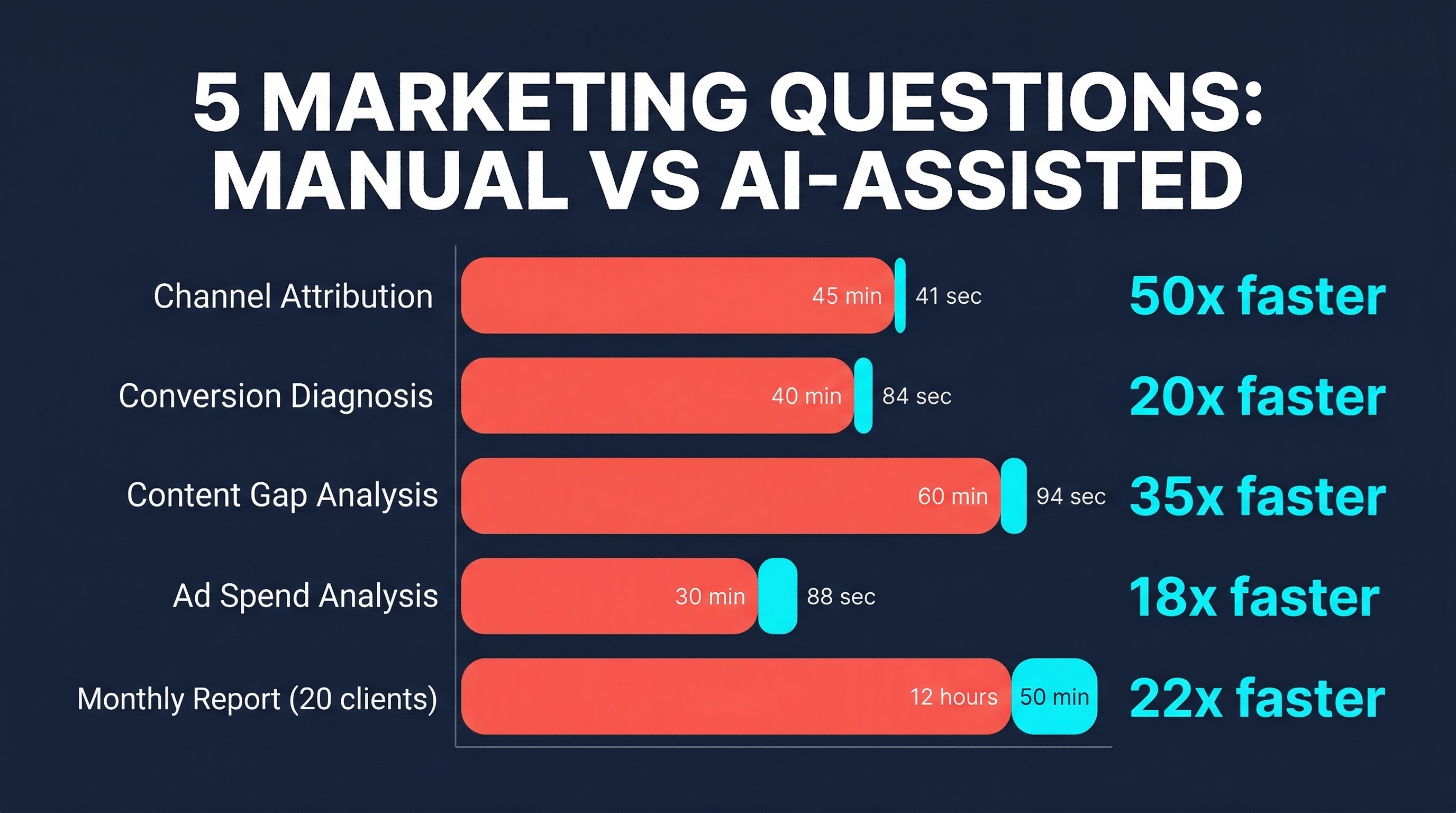
| Question | Manual Time | Agentcy | Speedup |
|---|---|---|---|
| Channel attribution | 30-45 min | 41s | ~50x |
| Conversion diagnosis | 20-40 min | 84s | ~20x |
| Content gap analysis | 45-60 min | 94s | ~35x |
| Ad spend analysis | 20-30 min | 88s | ~18x |
| Month-over-month summary | 30-45 min | 92s | ~25x |
Average: 80 seconds per query. Single-source queries (one data source) run faster (~40s). Cross-source queries that hit multiple APIs take longer (~90s) but return correlated insights that would take 3-5 separate manual lookups.
These five questions aren't edge cases. They're the questions every marketer asks every week. The only question is whether you answer them in 60 minutes or 60 seconds.